


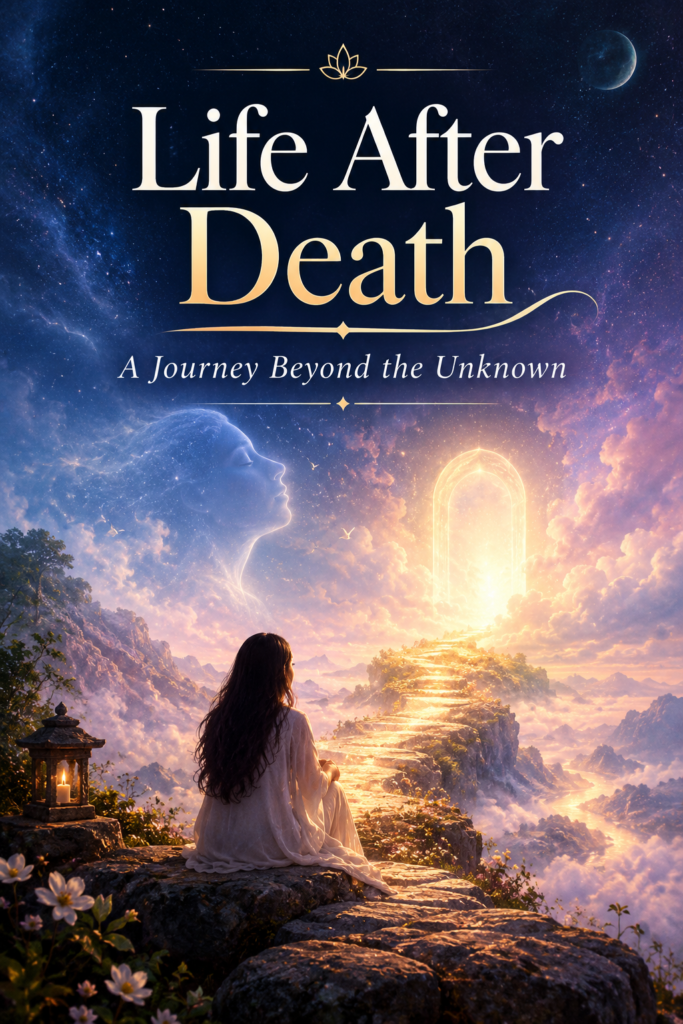
Life After Death: A Journey Beyond the Unknown
What happens when our final breath fades away? Does our existence come to an end, or does the soul continue its journey into a reality beyond human understanding?
There are questions that remain with us throughout our lives, quietly appearing in moments of silence, beneath the stars, or when we think about the people we have loved and lost. Among these questions, one stands above the rest: What happens after death?
For centuries, humanity has searched for an answer. Religions have offered promises of eternity, philosophers have questioned the nature of existence, and science has explored the mysteries of consciousness. Yet, despite all our knowledge, the final destination of human consciousness remains unknown.
Perhaps life after death is not simply a question about what happens when we leave this world. Perhaps it is also a question about who we are, why we exist, and what it truly means to be alive.
1. The Mystery That Lies Beyond Death
Death is one of the few experiences that every human being must eventually face, yet no one can return with a universally verified explanation of what it is like to exist beyond it.
We can observe the physical body grow, change, and eventually cease functioning. But the deeper questions remain. Is consciousness entirely dependent on the brain? Is there something about human existence that science has not yet fully understood? Or is the idea of an afterlife a reflection of our desire for meaning and permanence?
These questions invite us to look beyond simple answers.
The unknown can be frightening, but it can also inspire wonder. Throughout history, people have looked at the night sky, contemplated the universe, and wondered whether reality extends beyond what our senses can perceive.
Perhaps the mystery of death reminds us that human understanding, however remarkable, still has its limits.
2. The Soul: Something Beyond the Physical Body?
Many spiritual traditions distinguish between the physical body and a deeper spiritual essence often called the soul.
In Hindu philosophy, the Atman is understood as the innermost self, distinct from the temporary physical body. The Bhagavad Gita presents the soul as eternal, describing physical death as a change rather than the ultimate destruction of the self.
In other spiritual traditions, the soul represents the unique spiritual identity of a person and its relationship with the divine.
Philosophers have also debated whether consciousness can be reduced entirely to physical processes or whether its nature raises deeper questions about existence.
However, spiritual beliefs about the soul are not the same as scientifically established facts. Science has not confirmed that a soul exists independently of the body.
Still, the idea encourages an important reflection: Are we merely the physical forms we inhabit, or is there more to human existence than what can be seen and measured?
The question itself has shaped centuries of spiritual and philosophical thought.
3. Reincarnation: Does Life Begin Again?
One of the most fascinating beliefs about life after death is reincarnation.
In Hinduism, the cycle of birth, death, and rebirth is known as samsara. Rebirth is connected to karma, the principle that actions have consequences. Spiritual liberation, known as moksha, means freedom from this cycle.
Buddhist traditions also teach rebirth, although Buddhist philosophy generally rejects the idea of an unchanging, permanent soul passing from one life to another.
These traditions offer different ways of understanding continuity beyond a single lifetime.
Imagine a river flowing through different landscapes. Its surroundings change, its appearance transforms, and yet the movement of water continues. Some people use similar images to contemplate the possibility of existence beyond one physical life.
Of course, this is a metaphor rather than proof of reincarnation.
Whether rebirth is a spiritual reality or a belief through which people understand existence, it raises meaningful questions about responsibility, compassion, and the consequences of our actions.
If our actions matter beyond the present moment, then how we live today becomes especially significant.
4. What Does Science Say About Life After Death?
Spirituality asks questions about meaning and ultimate reality. Science approaches the subject through observation, evidence, and testable explanations.
Modern science has established strong connections between consciousness and brain activity. Changes to the brain can affect memory, personality, perception, and awareness. When the brain permanently ceases functioning, the familiar biological processes that support conscious experience also end.
Some people who have experienced near-death situations report vivid experiences, feelings of peace, bright lights, or a sense of leaving their bodies. Researchers study these reports to understand how the brain and mind function under extreme conditions.
However, near-death experiences do not establish that consciousness continues after irreversible death.
At present, there is no conclusive scientific evidence proving that personal consciousness survives death. Nor has science answered every philosophical question about why subjective experience exists in the first place.
Recognizing this distinction allows us to approach the subject with both curiosity and intellectual honesty.
We can remain open to questions without treating every possibility as a proven truth.
5. Why Are We Afraid of Death?
Perhaps our fear of death comes partly from uncertainty.
We fear losing the people who make our lives meaningful. We worry about unfinished dreams, unspoken words, and experiences we may never have. We wonder whether everything we have worked for will eventually disappear.
Yet there may be another reason death affects us so deeply: it reminds us that our time is limited.
When we understand that life is temporary, ordinary moments can become extraordinary. A conversation with a friend, a meal shared with family, the warmth of sunlight, or a quiet evening can suddenly feel more valuable.
The impermanence of life does not necessarily make it meaningless. In many philosophical traditions, it is precisely impermanence that gives life its urgency and beauty.
A sunset is beautiful partly because it does not remain forever. A moment becomes a memory because time continues to move.
Perhaps the purpose of contemplating death is not to live in fear of it, but to learn how to live more consciously.
6. Could Love Be a Form of Immortality?
Consider the people who have changed your life.
Their words may become part of your inner voice. Their kindness may influence how you treat others. Their lessons may guide decisions they will never witness.
Even after someone dies, the effects of their life can continue through memories, relationships, stories, and the actions of those they influenced.
This does not prove that consciousness survives death. It reveals something we can observe in the world around us: human lives are connected in ways that extend beyond individual moments.
A kind act can inspire another kind act. A lesson can pass from one generation to the next. Love can shape a person’s life long after the original moment of connection has passed.
Perhaps one form of immortality is not the endless continuation of the individual, but the lasting influence we leave behind.
Our bodies are temporary, but the meaning we create together can travel further than we ever imagined.
7. What If We Never Discover the Answer?
Human beings naturally seek certainty. We want explanations that bring order to the unknown and answers that quiet our deepest questions.
But not every question has an answer available to us today.
We may never reach a universally accepted conclusion about life after death. Our understanding may change as philosophy, neuroscience, and other fields continue to develop. Religious and spiritual traditions will also continue to offer perspectives shaped by faith and experience.
There is wisdom in admitting what we do not know.
Uncertainty does not require us to abandon hope, and curiosity does not require us to accept every claim. We can explore spiritual ideas, examine scientific evidence, respect different beliefs, and still acknowledge the limits of our understanding.
Sometimes, a profound question can transform us even when it does not provide a final answer.
The question of death can lead us toward a deeper appreciation of life.
8. Living Before the Final Goodbye
Whatever may lie beyond death, the present moment is where we can make choices.
We can choose kindness over cruelty, understanding over judgment, and gratitude over taking everything for granted. We can repair relationships, pursue meaningful dreams, and spend time with the people who matter to us.
We do not need to solve the mystery of eternity before deciding what kind of life we want to live.
If there is an afterlife, living with compassion may be meaningful within our spiritual understanding of it. If there is no continuation of personal consciousness, compassion remains meaningful because it shapes the lives of living people.
Either way, the opportunity to make a positive difference exists now.
Perhaps the most valuable response to life’s uncertainty is not to demand complete knowledge of tomorrow, but to live with greater awareness today.
Conclusion: Beyond the Unknown
Life after death remains one of humanity’s deepest mysteries.
For some, it is a promise of eternal life. For others, it is the possibility of rebirth. For still others, it is an unanswered question approached through science and philosophy.
We may hold different beliefs, and we may never agree on a single explanation. Yet we share the experience of living in a world filled with beauty, uncertainty, connection, and change.
Perhaps we should not measure the value of life only by how long it lasts, but by how deeply it is experienced and how much goodness it brings into the world.
Maybe the greatest lesson hidden within the mystery of death is a reminder to live while we can: to love sincerely, to forgive when possible, to remain curious, and to treat each day as an opportunity rather than a guarantee.
We may not know what waits beyond the final goodbye. But we can decide what our lives mean before that goodbye arrives.
And perhaps that is where the mystery of death leads us—not away from life, but back toward it, with a little more wonder, a little more humility, and a deeper understanding of how precious our time truly is.
Comments (0)
No comments yet — be the first to say something.